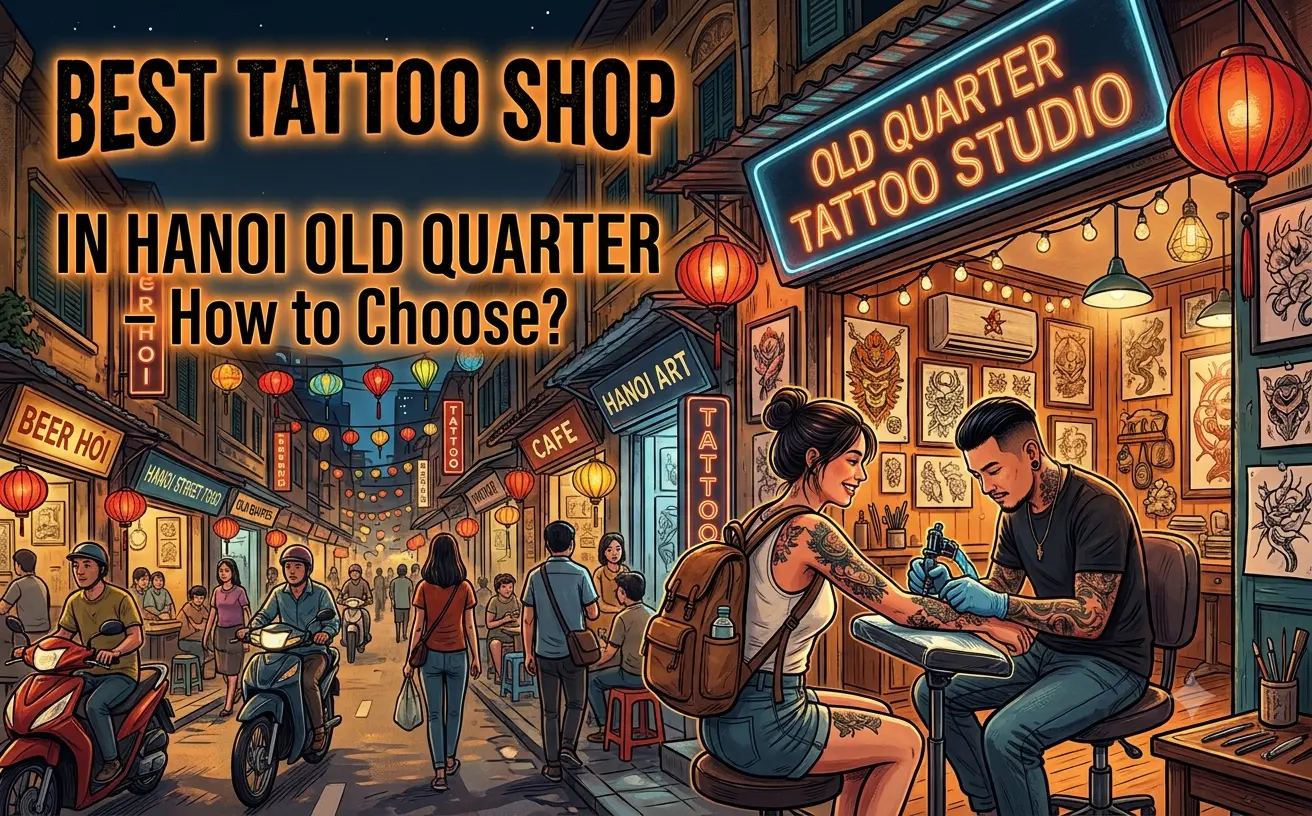
Hanoi’s Old Quarter has been a place of craft for nearly a thousand years. Its famous “36 Streets” were once organized by guild, with silversmiths on one lane, silk merchants on another, and lacquer and paper artisans a few steps away. Walk those same streets today and you’ll find a new generation of makers working with ink and skin.
For travelers and locals alike, that creates a pleasant problem: the choice is wide, and quality varies a great deal. A tattoo is permanent, so this guide covers what to check before you sit in the chair.
Why the Old Quarter Is a Natural Home for Tattoo Art
The Old Quarter’s craft heritage and its mix of visitors make it a creative crossroads. Travelers bring references from Japanese irezumi, American traditional, Polynesian patterns, and minimalist fine-line work. Vietnamese clients increasingly seek designs rooted in local motifs such as lotus, dragon, crane, and bamboo.
The result is a demanding, design-literate audience. But a central location does not guarantee quality. The best tattoo shop in Hanoi Old Quarter isn’t the one with the most prominent sign. It’s the one that meets professional standards in every area below.
1. Hygiene and Safety: The Non-Negotiable Standard
Before you consider style or price, evaluate safety. Tattooing breaks the skin, so a studio’s sterility practices matter more than anything on its walls.
What to look for
- Single-use, sterile needles and cartridges, opened in front of you from sealed packaging.
- Fresh gloves worn throughout, changed whenever they touch anything non-sterile.
- Barrier protection on machines, power cords, and clip cords, plus a disinfected station.
- Disposable ink caps, never shared between clients.
- A clean, dedicated workspace separate from any waiting or retail area.
- Reputable pigments from established manufacturers, with the artist willing to say which brands they use.
Red flags
- Needles that are not sealed or are reused.
- An artist who is reluctant to discuss their sterilization process.
- Cluttered stations, unwrapped equipment, or no handwashing before gloving.
A professional will welcome your questions. If a studio treats them as an inconvenience, walk away.
2. Evaluate the Artist’s Portfolio, Not Just the Studio’s
A studio is only as good as the artist who works on you, so review portfolios critically.
Look for healed work
Fresh tattoos photographed under flattering light can hide problems. Healed photos show whether lines stayed crisp, whether shading stayed smooth, and whether color held its saturation. Ask to see healed examples of the style you want.
Match the artist to the style
Tattooing is highly specialized, and few artists excel at everything. Judge by technique:
- Fine-line work depends on steady needle lining, usually with small round-liner configurations. Look for consistent line weight and no “blowouts,” where ink spreads beneath the skin and blurs the line.
- Bold traditional relies on solid, saturated color packing and confident, thick outlines that age well.
- Stippling and dotwork require patience and even density, creating tone from thousands of deliberate points.
- Black-and-gray shading demands smooth gradients without patchiness, typically achieved with magnum configurations.
If a portfolio shows only one style, that artist is probably a specialist. That’s a strength when it matches your idea.
3. The Custom Design Process Tells You Everything
Flash sheets have their place, but a meaningful tattoo should fit your body, not just exist on a wall. Premium studios treat design as a collaboration.
What a good consultation looks like
- Discussion. The artist asks about your concept, references, and preferred placement.
- Anatomy and flow. A good designer considers how the tattoo moves with your muscles and curves, not just how it looks flat on paper.
- Sizing and detail. An honest artist will tell you if a design is too small or too intricate to age well. Very fine detail can blur over time, and good artists say so even when it means a smaller sale.
- Revisions. You should be able to refine the design before any ink touches skin.
An artist who rushes the consultation or traces an image without adapting it is not delivering custom work.
4. Technical Knowledge Reveals Professionalism
You don’t need to be an expert, but a few questions can show how deep an artist’s knowledge runs:
- “Which needle configuration will you use for this design, and why?”
- “How will this look after it heals, and in five years?”
- “What aftercare do you recommend for this placement?”
Confident, specific answers suggest real experience. Vague or defensive ones suggest otherwise.
5. Aftercare: Where a Good Studio Proves Its Commitment
A tattoo is only as good as the way it heals. Reputable studios give clear written or verbal aftercare instructions, because a flawless session can still be spoiled by poor healing.
Typical healing stages
- Days 1–3: The skin is tender and slightly red. Plasma and excess ink may seep.
- Days 4–14: Peeling and itching begin. Do not pick or scratch.
- Weeks 2–4: The surface skin looks healed, though the tattoo can appear cloudy or dull.
- Up to 3 months: Deeper layers settle and the final look emerges.
General principles
- Wash gently with mild, fragrance-free soap, and pat dry.
- Apply a thin layer of recommended ointment or lotion as advised by your artist.
- Avoid soaking, swimming pools, and direct sun while healing.
- Once healed, use sunscreen daily to protect color and line clarity.
Note that Hanoi’s climate is hot and humid for much of the year, so ask your artist about sweat, friction, and clothing choices during healing. Good studios also offer touch-up advice if any areas heal unevenly.
6. Communication, Atmosphere, and Trust
Finally, trust your instincts. The best studios feel welcoming and unhurried. The artist should speak clearly, answer questions patiently, and never pressure you into a design or an immediate booking. If you are traveling, check that the studio can communicate comfortably in English and plan sessions around your schedule.
On price: Cheap tattoos are rarely good, and good tattoos are rarely cheap. Treat a very low quote as a signal to ask harder questions about hygiene, materials, and experience.
Quick Checklist: Choosing a Tattoo Studio in Hanoi
| Question | What you want to see |
|---|---|
| Are needles sealed and single-use? | Yes, opened in front of you |
| Does the portfolio include healed work? | Yes, in your chosen style |
| Is design truly custom? | Yes, with a consultation and revisions |
| Is aftercare explained clearly? | Yes, with written guidance |
| Is the artist honest about limits? | Yes, even if it changes the plan |
Your Next Step: Custom Tattoo Art in the Heart of the Old Quarter
If you’ve been weighing your options, the right choice comes down to craft, cleanliness, and care. Mr Tattoo Hanoi Studio was built around exactly those principles, right in the center of Hanoi’s Old Quarter, a short walk from the lanes where the city’s artisans have worked for centuries.
At Mr Tattoo Hanoi Studio, every piece is custom-designed with you, from first sketch to final line, with strict hygiene standards and professional aftercare guidance so your tattoo heals as beautifully as it was drawn. Whether you want delicate fine-line work, bold traditional imagery, or a design inspired by Vietnamese culture, our team will help you shape an idea into lasting art.
Ready to start? We’d love to hear your idea.
- WhatsApp / Hotline: +84 377 616 886
- Website: mrtattoo.vn
- Book a consultation: mrtattoo.vn/contact/
Visitors and locals are equally welcome. Message us on WhatsApp or drop into the studio, and let’s design something worth keeping for life.