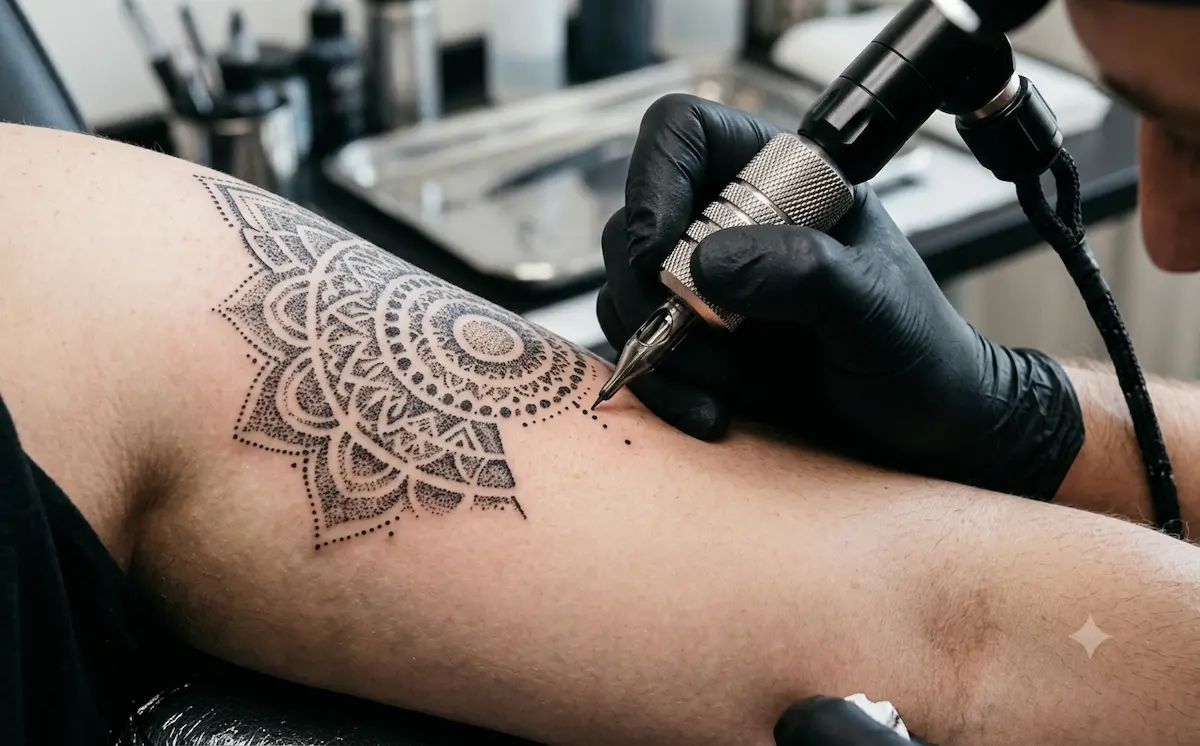
Look closely at a well-made dotwork tattoo and you will find thousands of tiny points of ink, each placed with intent. From a distance, those points dissolve into smooth gradients, glowing geometry, and surprisingly soft depth. Dotwork tattoos are among the most meditative forms of body art, and they reward both the artist’s patience and the wearer’s eye for detail.
This guide covers what dotwork is, where the technique comes from, how it is executed, and how to look after it so it stays crisp for years.
What Is a Dotwork Tattoo?
A dotwork tattoo (also called stippling or pointillism tattooing) builds an image entirely from individual dots rather than solid lines or packed colour. Artists control tone through dot density. Closely clustered dots read as dark, widely spaced dots read as light, and the gradient between them creates shading without a single blended fill.
Dotwork is often combined with other styles:
- Geometric and mandala work: Symmetry and sacred geometry, where dots add texture and glow.
- Blackwork and ornamental designs: Bold shapes balanced by delicate stippled gradients.
- Fine line and illustrative work: Botanical, anatomical, and engraving-style pieces.
- Realism and nature subjects: Animals, landscapes, and celestial themes with soft, grainy depth.
History and Cultural Origins
Dots as a mark-making device are as old as art itself, and many traditional tattooing cultures worked by tapping or poking pigment into skin by hand, an inherently point-by-point method. Hand-tapped traditions across Asia and the Pacific, including Polynesian tatau and Southeast Asian tapped tattoos, still demonstrate how powerful repeated, deliberate marks can be.
In Western fine art, stippling has a long engraving and illustration heritage, and the late-19th-century Pointillist movement, associated with Georges Seurat, showed how separate dots of tone can merge in the viewer’s eye. Contemporary dotwork tattooing draws on this visual logic. Its modern popularity grew alongside the revival of blackwork and sacred geometry in the 2000s and 2010s, helped by the rise of hand-poke practice and by social media, where the style’s texture and symmetry photograph beautifully.
How Dotwork Tattoos Are Made
Needles and Machines
Most dotwork uses round liner (RL) needle groupings, such as 1RL, 3RL, or 5RL, in a range of diameters. Smaller groupings give precise control for fine detail, while slightly larger ones help fill areas with consistent dots.
| Setup | Typical Use |
|---|---|
| 1RL / 3RL | Delicate dots, light gradients, small details |
| 5RL / 7RL | Faster coverage of denser areas |
| Round shader (RS) | Tight, dense stippled shading |
Artists work in two main ways:
- Machine dotwork: Rotary or coil machines run at a controlled, often slower speed, so each strike lands as a distinct dot rather than a dragged line.
- Hand-poke dotwork: The artist places each dot manually with a sterile needle, offering a distinctive texture and a calm, deliberate process.
Both are valid. The best choice depends on the design, the skin area, and the artist’s strengths.
Technique and Craft
Dotwork looks simple, but consistency is the hard part. Skilled artists manage:
- Dot size and depth: Uniform depth keeps dots even. Too deep and they can spread; too shallow and they fade or look patchy.
- Spacing and gradient planning: Smooth tonal transitions come from gradually changing density, not random scattering.
- Skin tension: Stretching the skin properly keeps dots round instead of oval.
- Symmetry and alignment: Geometric pieces demand accurate stencils and steady measurement.
Because the process is slow, dotwork sessions can take longer than line-based pieces of the same size. That time is part of what gives the finished work its richness.
Pigment Choice
Most dotwork is done in black ink, which gives the strongest contrast and tends to hold well. Some artists add grey wash dilutions or a touch of colour, but high-quality, properly labelled pigment matters most in a style where every dot must stay legible.
Dotwork vs. Fine Line: What’s the Difference?
The two are often confused but achieve different effects. Fine line uses continuous thin strokes to define form, while dotwork uses accumulated points to create tone and texture. Many contemporary designs blend both: a fine line outline filled with stippled shading is a classic combination.
How Do Dotwork Tattoos Age?
Dotwork generally ages well because it relies on spaced black dots rather than large saturated areas. Still, every tattoo changes over time, and a few principles apply:
- Allow breathing room. Dots placed too closely can merge as ink naturally diffuses in the skin.
- Choose a suitable size. Very small designs with extreme detail may soften sooner than slightly larger compositions.
- Think about placement. Stable areas such as the upper arm, forearm, thigh, and back hold detail better than high-friction zones like fingers, palms, and feet.
- Protect from the sun. Daily SPF on healed skin is the best long-term habit for preserving contrast.
Scientific Aftercare and Healing Stages
Healing timelines vary by person and placement, but most tattoos follow a similar pattern.
Days 1-3: Initial Healing
The area may be tender, warm, and slightly weepy. Follow your artist’s bandage instructions, keep the area clean, and avoid touching it with unwashed hands.
Days 4-14: Peeling and Itching
Light flaking and itching are normal as the surface renews. Wash gently with mild, fragrance-free soap, pat dry, and apply a thin layer of recommended aftercare product. Never pick or scratch.
Weeks 2-4: Surface Recovery
The outer skin closes, though the tattoo can look slightly cloudy or dull while deeper layers finish healing.
Months 2-3: Deeper Settling
The final appearance emerges as the skin fully settles.
Key aftercare principles:
- Avoid soaking (pools, baths, sea) and direct sun during healing.
- Wear loose, clean clothing over the tattoo.
- Use thin layers of moisturiser, since over-application can hinder healing.
- Contact your artist if you notice persistent redness, swelling, heat, or unusual discharge.
Touch-Ups
Because dotwork depends on many small points, tiny gaps or uneven density can appear during healing. A touch-up after about 6-8 weeks, once the skin has fully healed, helps even out saturation and refine gradients.
Hygiene and Safety Standards
Intricate work involves a large number of needle strikes, which makes hygiene even more important. A professional studio should provide:
- Single-use, sterile needles and tubes, opened in front of you
- Disposable gloves, barrier protection, and sanitised workstations
- Reputable, properly labelled pigments
- Autoclave sterilisation for any reusable equipment
- A clear consultation and health screening before the session
If a studio cannot explain its protocols clearly, choose another.
Choosing the Right Dotwork Artist
Review portfolios for healed work, not just fresh photos. Look for smooth tonal gradients, evenly sized dots, clean symmetry, and no visible clustering or blowout. Ask about their stencil process, needle choices, and how they plan density and placement for longevity.
Your Dotwork Tattoo in Hanoi
If you are ready to turn a geometric idea, a mandala, or a stippled illustration into permanent art, Mr Tattoo Hanoi Studio welcomes you in the heart of Hanoi’s Old Quarter. We specialise in custom-designed tattoos, where every piece is drawn for you rather than copied from a template, with strict hygiene standards and a refined artistic eye. Whether you are travelling through the city or live here, our team will guide you from first sketch to final aftercare.
Ready to begin?
- WhatsApp / Hotline: +84 377 616 886
- Website: mrtattoo.vn
- Book a consultation: mrtattoo.vn/contact
Send us a message, share your idea, and let’s build something precise, patient, and beautiful, one dot at a time.