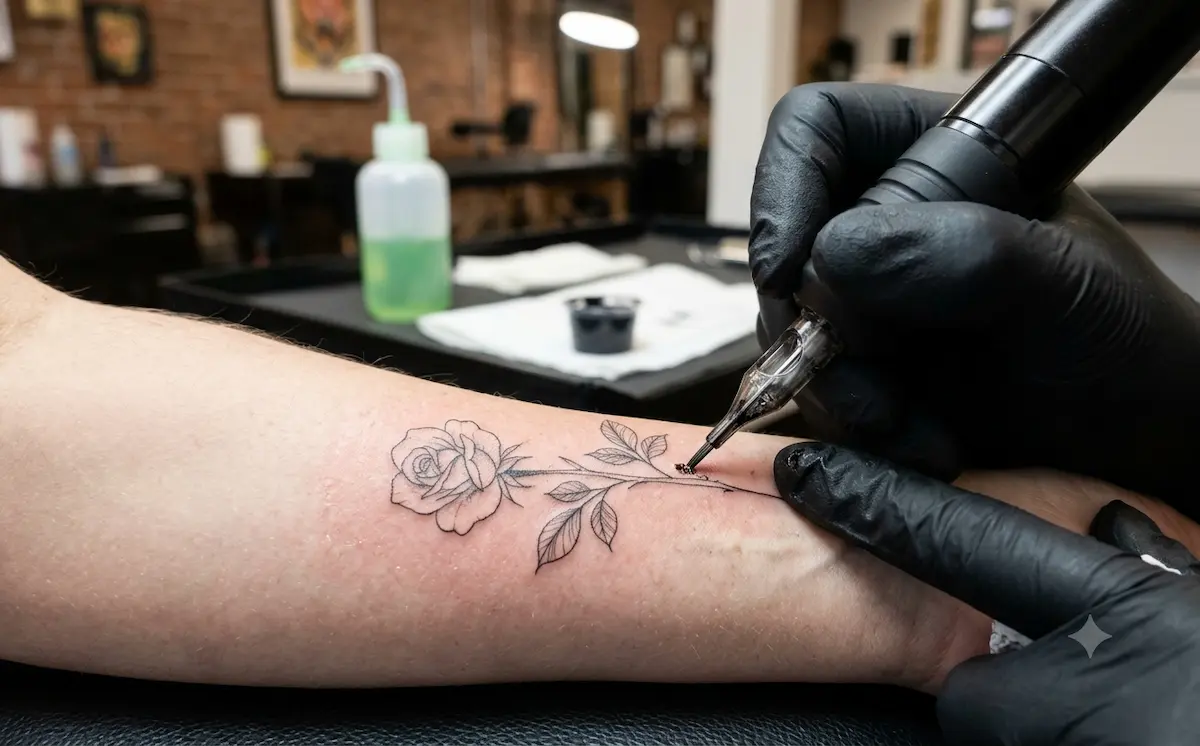
Some of the most striking tattoos today are barely there at all. A single-needle botanical sprig along a collarbone, a hairline-thin constellation behind the ear, a minimalist portrait that looks pencil-drawn on skin. Fine line tattoos have moved from a niche specialty to one of the most requested styles worldwide. Behind their quiet elegance lies serious technical discipline, and the line between a graceful result and a blurred one is measured in fractions of a millimetre.
This guide covers what a fine line tattoo is, how it is made, how it ages, and how to care for it properly.
What Is a Fine Line Tattoo?
A fine line tattoo is defined by thin, precise, delicate linework, typically created with small needle configurations and a light hand. Where bold traditional styles rely on thick outlines and saturated colour blocks, fine line work relies on restraint, spacing, and negative space.
You will often see the style described alongside related terms:
- Single-needle tattoos: Work created with one needle (often a 1RL), producing the finest possible line.
- Micro-realism: Miniature, photographic-looking subjects built from very small detail.
- Minimalist tattoos: Simple outlines with little or no shading.
- Illustrative fine line: Pen-and-ink or etching-style artwork, often with delicate hatching or stippling.
A Brief History: From Tradition to Modern Minimalism
Thin, precise linework is not new. Many traditional hand-tapped and hand-poked practices across Asia and the Pacific involved careful, small-scale detail long before electric machines existed. The modern fine line movement, however, grew from several forces in the late 20th and early 21st centuries: improvements in needle manufacturing, rotary machine technology, and the influence of fine art, botanical illustration, and engraving traditions on tattoo design.
Social media accelerated the trend. Subtle, wearable, easily placed designs appealed to people who wanted a first tattoo that felt personal rather than loud. Today, fine line work stands alongside blackwork, Japanese, and neo-traditional as a core style in professional studios worldwide.
How Fine Line Tattoos Are Made
Needles and Machines
Fine line work typically uses round liner (RL) needle groupings, such as a 1RL or 3RL, in thinner diameters. Common needle diameters are:
| Gauge | Diameter | Typical Use |
|---|---|---|
| #6 (Ultra-fine) | 0.20 mm | Hairline detail, micro-work |
| #8 (Bugpin / Standard) | 0.25 mm | Fine to medium linework |
| #10 (Standard) | 0.30 mm | Slightly bolder lines, stability |
Many artists use lightweight rotary pen machines, which offer smooth, consistent movement and precise control. Some also combine machine work with hand-poke methods for particular textures.
Linework Skill
The needle is only part of the equation. Fine lines are unforgiving because there is nowhere to hide a shaky stroke. Skilled artists control:
- Depth: Too shallow and the line fades or patches; too deep and ink spreads beneath the skin, a problem called “blowout.”
- Speed and hand movement: Steady, confident pulls produce clean, even lines.
- Stretch and angle: Proper skin tension and needle angle prevent wobble and uneven saturation.
- Spacing: Details placed too close together can merge over time.
Shading and Stippling
Although often associated with outlines, fine line work frequently includes stippling (building tone from tiny dots) and delicate whip shading or hatching. These techniques add depth while preserving the airy look of the style.
Do Fine Line Tattoos Last?
This is the question every thoughtful client should ask. Fine line tattoos can age beautifully, but they need realistic expectations.
Because the lines are thin, small changes in the skin show more clearly. Over the years, natural ink diffusion can slightly soften lines, and sun exposure speeds fading. Placement matters too. Areas with frequent friction or high skin renewal, such as fingers, palms, feet, and inner lips, tend to lose definition faster than stable areas like the upper arm, forearm, or calf.
To maximise longevity, a good artist will advise on:
- Appropriate size: Very tiny designs with intricate detail may blur sooner than slightly larger compositions.
- Line spacing: Leaving enough breathing room between elements.
- Placement: Choosing stable, lower-friction skin zones.
- Sun protection: Daily SPF on healed tattoos is the single best long-term habit.
A good fine line tattoo is designed to age gracefully, not just to look sharp on day one.
Scientific Aftercare and Healing Stages
Delicate work deserves careful healing. While individual experiences vary, most tattoos follow a similar timeline.
Days 1-3: Initial Healing
The skin is tender, warm, and may weep plasma. Keep the area clean, follow your artist’s bandage instructions, and avoid picking or scratching.
Days 4-14: Peeling and Itching
Light flaking and itchiness appear as the surface skin renews. Wash gently with mild, fragrance-free soap, pat dry, and apply a thin layer of a recommended aftercare product. Never scratch or peel.
Weeks 2-4: Surface Recovery
The top layer typically closes, though the tattoo may look slightly dull or cloudy as the skin finishes healing.
Months 2-3: Deeper Settling
Deeper skin layers continue to settle, and the true final appearance emerges.
Key aftercare principles:
- Avoid soaking (pools, baths, sea) and direct sun during healing.
- Wear loose, clean clothing over the area.
- Use only thin layers of moisturiser; over-applying can suffocate healing skin.
- Contact your artist if you notice persistent redness, swelling, heat, or unusual discharge.
Touch-Ups
Fine lines sometimes heal unevenly, with small gaps or light spots. A touch-up after about 6-8 weeks, once the skin has fully healed, is common practice and is often included by reputable studios.
Hygiene and Safety: Non-Negotiable Standards
Precision means nothing without safety. A professional studio should always use:
- Single-use, sterile needles and tubes, opened in front of you
- Disposable gloves, barrier film, and sanitised workstations
- Reputable, properly labelled pigments
- Autoclave sterilisation for any reusable equipment
- Clear health screening and consultation before starting
If a studio cannot answer questions about its hygiene protocols, look elsewhere.
Choosing the Right Artist for Fine Line Work
Look for an artist with a portfolio of healed fine line tattoos, not just fresh photos. Healed results reveal the true skill: consistent line weight, clean curves, and minimal blowout. Ask about their custom design process, their needle and machine choices, and their approach to placement and sizing.
Your Fine Line Tattoo in Hanoi
If you’re ready to bring a delicate idea to life, Mr Tattoo Hanoi Studio welcomes you in the heart of Hanoi’s Old Quarter. We specialise in custom-designed tattoos, where every piece is drawn for you rather than copied from a template, with strict hygiene standards and a refined artistic eye. Whether you’re a visitor exploring the city or a local seeking a thoughtful first tattoo, our team will guide you from concept sketch to aftercare.
Ready to start?
- WhatsApp / Hotline: +84 377 616 886
- Website: mrtattoo.vn
- Book a consultation: mrtattoo.vn/contact
Message us today, share your idea, and let’s design something quietly extraordinary together.