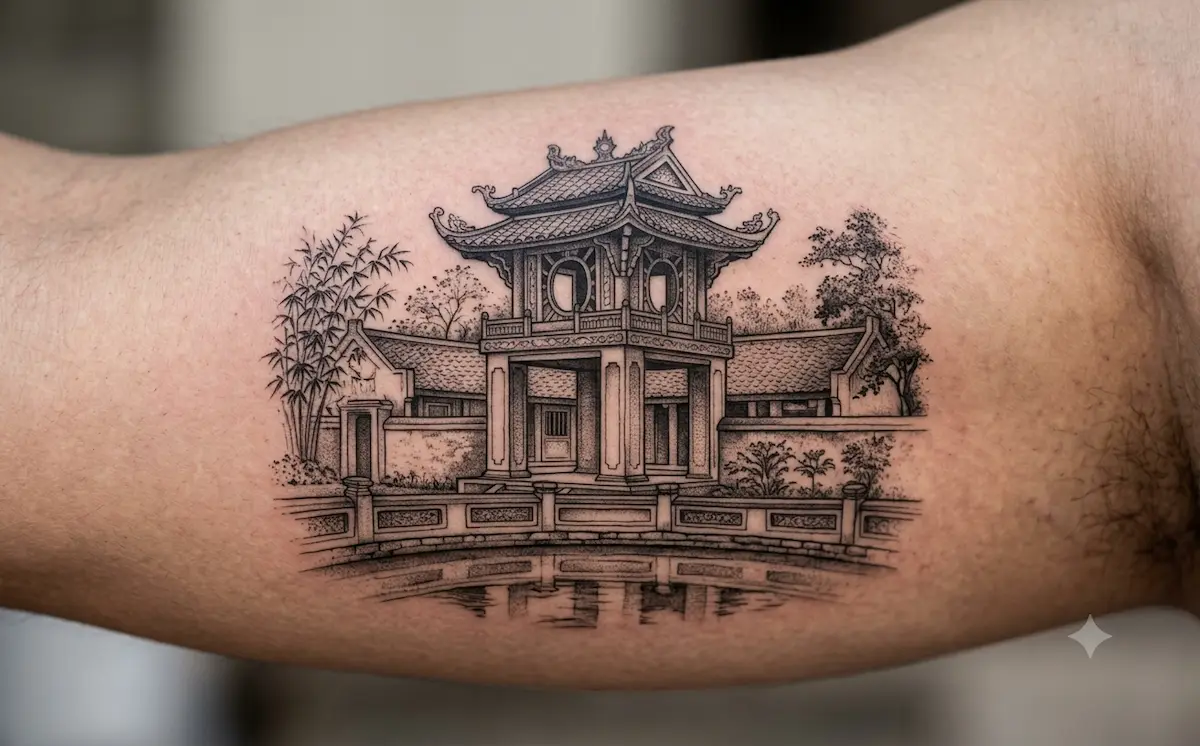
Carrying Hanoi’s Constellation of Literature on Your Skin
Some places do not simply sit in a city; they quietly define its soul. In Hanoi, few images hold that role as gracefully as Khue Van Cac, the Constellation of Literature Pavilion. Rising above the courtyards of the Temple of Literature, its slender wooden frame, eight curved roofs and round, star-like windows have watched over generations of scholars. Today, this silhouette is recognized across Vietnam as an emblem of Hanoi, and it appears on the 100,000 dong banknote. For many, it is also becoming something more intimate: a Khue Van Cac tattoo that speaks of learning, aspiration and belonging.
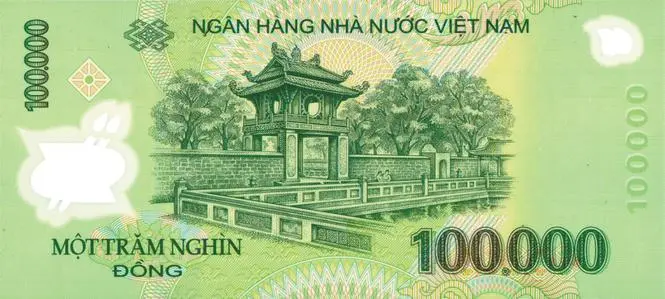
The Story Behind Khue Van Cac
The Temple of Literature (Van Mieu – Quoc Tu Giam) was founded in 1070 to honor Confucius and later became Vietnam’s first national university. Within its walls, Khue Van Cac, built in the early 19th century, stands before the Well of Heavenly Clarity as a pavilion dedicated to scholarship and excellence.
Its name carries the poetry. Khue refers to the Kui star, a constellation that traditional East Asian belief associates with literature and learning. To call a pavilion “Khue Van Cac” is to say that knowledge shines in the sky like a star, and that those who pursue it are guided by its light.
What Does a Khue Van Cac Tattoo Symbolize?
Knowledge and the Lifelong Pursuit of Wisdom
At its heart, this tattoo honors learning as a way of life. It suits students, teachers, writers, designers and anyone who treats curiosity as a quiet discipline. It is not a symbol of finished achievement, but of the continuing path.
Aspiration and Perseverance
For centuries, scholars passed beneath the temple’s gates hoping to rise through study and effort. The pavilion, lifted above the ground on stout pillars, reflects that ascent: patience, resilience and the dignity of earning your place through work.
Harmony, Balance and Feng Shui
In traditional thought, the round windows evoke the heavens, while the pavilion’s grounded base speaks to earth. Together they form an image of harmony between sky and earth, ambition and humility. Its symmetrical, balanced architecture is often read as a emblem of stability and inner order. As with all symbolism, the meaning you feel matters more than any prescribed interpretation.
A Love Letter to Hanoi
For those born in Hanoi, or those who have made it home, the pavilion is a symbol of identity and memory: the scent of old trees, the quiet of a courtyard, the city’s patient, scholarly spirit.
Best Placements for a Khue Van Cac Tattoo
Because the pavilion is vertical and elegantly proportioned, it flatters body areas that allow its structure to breathe.
- Forearm (inner or outer): The long, narrow canvas suits the pavilion’s height, and the design stays visible as a daily reminder.
- Upper arm or shoulder: Offers room for fine architectural detail, and can be extended with clouds, stars or bamboo.
- Calf or shin: A strong vertical line that echoes the pavilion’s upward stance.
- Ribs or upper back: Ideal for larger, more contemplative compositions that frame the pavilion within a night sky of stars.
- Behind the ear or collarbone (small versions): Perfect for a discreet, minimalist emblem.
A thoughtful artist will adapt scale and angle to your anatomy, so the design follows your muscles and contours rather than sitting on top of them.
Choosing the Right Style
Fine-line: Quiet Elegance
Delicate fine-line tattooing captures the pavilion’s slender beams and eight-roof silhouette with precision. It is a refined choice for a small, understated piece that reads like an architectural sketch.
Blackwork: Depth and Presence
With bold contrast and deliberate shading, blackwork gives the pavilion a sculptural, dramatic quality. Silhouetted against a dark sky of dotted stars, it feels timeless and powerful.
Traditional Asian-inspired Color
Drawing on East Asian visual language, this approach can bring in warm vermilion, deep teal and golden tones, along with clouds, lotus or bamboo. It honors the pavilion’s cultural roots and its place in Vietnam’s heritage.
Illustrative or Dotwork
For a more artistic interpretation, dotwork can render the constellation theme, with the Kui star glowing above the pavilion in fine, luminous points.
A Meaningful Memory for Travelers to Hanoi
For international visitors, a tattoo is rarely a souvenir; it is a memory made permanent. Walking through the Temple of Literature, sensing its stillness in the middle of a lively city, and then carrying its symbol home creates a connection that postcards cannot offer.
A Khue Van Cac tattoo can mark a trip, a season of life or a personal turning point. Because it represents learning and growth, it resonates with travelers who see their journeys as a form of education. Many visitors choose to personalize it with a date, a small Vietnamese phrase or a symbol from their own culture, joining two stories in one design.
If you are planning a tattoo during your visit, it helps to book early, share your references, and leave a little time before your departure for the skin to settle. Your artist can guide you on aftercare so your piece heals beautifully, wherever you travel next.
Your Story, Designed Exclusively for You
At Mr Tattoo Hanoi Studio, we believe a meaningful tattoo should never feel copied from a catalog. Every piece can be created as a custom design, shaped around your story, your body and your sense of beauty. Whether you want a whisper-fine pavilion on your wrist or a grand composition across your back, our artists will listen first, then translate your intention into clean, lasting lines.
Khue Van Cac has stood for more than two centuries as a symbol of knowledge and quiet aspiration. Perhaps it reflects something in you, too.
Ready to turn your story into permanent art? Visit Mr Tattoo Hanoi Studio at mrtattoo.vn to share your idea and begin designing a Khue Van Cac tattoo that is entirely your own.